Message count based on recipient
This condition lets you filter messages based on how many messages a matching recipient has received within a time interval. This is useful for protecting mailboxes from being flooded, detecting mail loops, or spotting addresses that are being targeted with large volumes of mail.
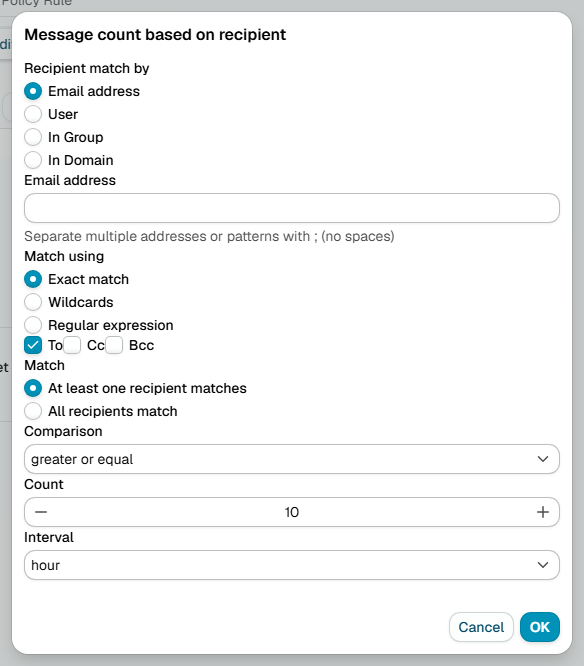
Recipient match by
Choose which recipients are counted:
Email address
Enter the recipient's email address and choose how to match it:
- Exact match - The email address must match exactly (e.g.
john@mshsoftware.com) - Wildcards - Use
*to match patterns (e.g.,*@mshsoftware.commatches anyone from that domain) - Regular expression - Use advanced pattern matching for complex rules
You can enter multiple addresses or patterns separated with ; (no spaces).
User
Select a specific user from the list. Only messages received by that user are counted.
In Group
Choose a group from the list. Messages are counted when the recipient belongs to that group.
In Domain
Select a domain. Messages are counted when the recipient's email address belongs to that domain.
Search email address in
Choose where to look for recipients: To, Cc, Bcc, or any combination of these fields.
Match
- At least one recipient matches - The message is counted if any recipient matches the criteria
- All recipients match - The message is counted only if every recipient matches the criteria
Comparison
Set how to compare the message count:
- Equal - Exactly matches the number you specify
- Not equal - Any count except the number you specify
- Greater than - More messages than the specified number
- Greater or equal - At least the specified number of messages
- Less than - Fewer messages than the specified number
- Less or equal - No more than the specified number of messages
Count
Number of messages to compare against.
Interval
The time window the messages are counted in, for example the last hour. The condition looks at how many matching messages were received within this interval and compares that number against the count.
Additional resources
- Domains - read more about domains, users and groups
- For information about regular expressions you could check regular-expressions.info or regexone.com